A sharp knife does more work than any gadget in your kitchen. The right blade cuts prep time in half. The wrong one fights you on every stroke. After cross-referencing manufacturer specs, professional reviews, and thousands of user ratings across platforms, we identified the best kitchen knives that cover every task a home cook faces — from dicing onions to splitting chickens to sawing through crusty sourdough.
This guide covers eight knife types. Each pick earned its spot through steel quality, edge retention, handle comfort, and real-world performance data from verified buyers. No filler picks. No pay-to-play rankings.
How We Evaluated These Kitchen Knives
We did not run a test kitchen trial. What we did: cross-referenced manufacturer-published specs (steel type, HRC hardness, blade angle, handle material) against professional reviews from sources including Serious Eats, America’s Test Kitchen, and Wirecutter. We then compared those findings against user review data on Amazon, filtering for verified purchases and looking at failure patterns (chipping, handle loosening, edge dulling) across thousands of ratings.
Each knife had to meet three criteria: a rating above 4.5 stars with at least 1,000 verified reviews, steel quality appropriate for its task, and a track record of holding an edge through normal home kitchen use. Knives that scored well in professional testing but had high user complaint rates for durability got cut from the list.
Wüsthof Classic 8-Inch: Best Overall Chef Knife
The Wüsthof Classic 8-inch chef knife is the workhorse pick for most home cooks who want one knife that handles 90 percent of kitchen tasks. Wüsthof forges this blade from a single piece of high-carbon stainless steel using their Precision Edge Technology, which sets the blade at a 14-degree angle per side. That is sharper than most Western-style knives out of the box.

★★★★★ (2,763 reviews)
The full tang runs through a triple-riveted polyoxymethylene handle. That handle material resists moisture and heat better than wood, according to Wüsthof’s published material specs. The blade weighs roughly 8.5 ounces, heavy enough for controlled rocking cuts but not so heavy that your wrist tires during extended prep sessions.
Professional reviewers at Serious Eats have consistently ranked the Wüsthof Classic among the top Western-style chef knives for its balance between sharpness and durability. The blade holds an edge through weeks of daily use before needing a honing steel. When it does dull, the softer steel (58 HRC) takes a new edge on a standard whetstone without much effort.
Victorinox Fibrox Pro 8-Inch: Best Budget Chef Knife
The Victorinox Fibrox Pro 8-inch is the best kitchen knife for cooks who want professional-grade performance without a premium price tag. Nearly 15,000 Amazon reviewers rate it 4.8 stars, the highest-reviewed chef knife we found at any price point.

★★★★★ (14,793 reviews)
Victorinox uses their proprietary high-carbon stainless steel, which the company tempers to 56 HRC according to their product specifications. That is slightly softer than German competitors, so the blade dulls faster under heavy use. The trade-off: it resharpens in minutes on a basic sharpener or honing rod.
The Fibrox handle is the standout feature. The thermoplastic elastomer grip is textured, slip-resistant, and rated for dishwasher use, though hand washing extends the blade’s life. Culinary schools across the country issue the Fibrox Pro to students. That is not marketing. The Culinary Institute of America and Johnson & Wales both stock Victorinox knives for incoming classes, a fact Victorinox publishes on their institutional sales page.
Tojiro DP Gyuto 8.2-Inch: Best Japanese Kitchen Knife
The Tojiro DP Gyuto is the entry point for home cooks who want Japanese steel performance at a fraction of the price of a Shun or Miyabi. Tojiro uses VG-10 cobalt alloy steel, the same grade found in knives costing three times as much.

★★★★½ (1,548 reviews)
VG-10 steel hardens to 60 HRC, which is 2-4 points harder than most German knives. Harder steel holds a sharper edge longer. The flip side: it chips more easily on bone or frozen food. This is a knife for precision cutting: thin-slicing fish, dicing vegetables, and mincing herbs. It is not for hacking through joints.
The blade uses a three-layer construction. A VG-10 core sits sandwiched between softer stainless steel outer layers, which protect the hard core from lateral stress. Serious Eats noted that this construction gives the Tojiro DP a thinner blade profile than Western knives, which translates to less resistance when slicing through dense vegetables like butternut squash. The best Japanese kitchen knives reward technique. If you already use a pinch grip and let the blade weight do the work, the Tojiro outperforms knives at twice the cost.
Victorinox Swiss Classic 7-Inch: Best Santoku Knife
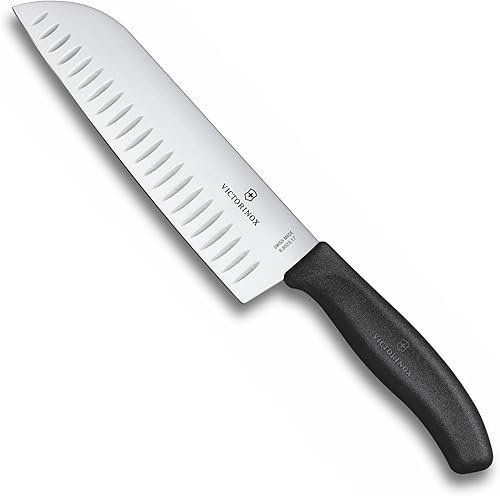
The Victorinox Swiss Classic 7-inch Santoku is a strong alternative for cooks who prefer a shorter, wider blade over a traditional chef knife. The Granton edge (those scalloped divots along the blade) creates small air pockets that help food release during slicing. If paper-thin cucumber rounds or garlic slices stick to your current knife, a Granton-edge santoku solves that problem.
★★★★★ (1,637 reviews)
The name “santoku” translates to “three virtues” in Japanese: slicing, dicing, and mincing. That describes the blade’s intended range. The flatter profile compared to a curved Western chef knife favors a straight up-and-down chopping motion rather than a rocking cut. Home cooks with smaller hands often find the shorter 7-inch blade more maneuverable than an 8-inch chef knife, according to user reviews that consistently mention hand size as a deciding factor. If you want to understand more about how these two knife styles compare, our santoku vs chef knife comparison breaks down the differences in detail.
Victorinox 3.25-Inch: Best Paring Knife
The Victorinox 3.25-inch paring knife handles the detail work that a chef knife cannot: peeling apples, deveining shrimp, hulling strawberries, trimming fat from cutlets. Over 7,000 Amazon buyers rate it 4.7 stars. At this size, blade steel matters less than comfort and control, and Victorinox nails both.

★★★★½ (7,293 reviews)
The straight spear-point blade tapers to a fine tip, which gives precise control for scoring, trimming, and in-hand cutting. Many professional cooks keep two or three paring knives in rotation because the small blades dull faster than larger knives during high-volume prep. At this knife’s price point, buying a pair and rotating them is a practical approach.
The lightweight construction (under 1 ounce) means you can hold it for 30 minutes of garlic prep without fatigue. The polypropylene handle is simple but functional: slip-resistant, dishwasher-safe, and color-coded options exist for food-safety compliance in commercial kitchens.
Victorinox 10.25-Inch Fibrox: Best Bread Knife
A dull bread knife crushes loaves instead of cutting them. The Victorinox 10.25-inch Fibrox bread knife uses an ultra-sharp serrated edge that grips crusty exteriors like sourdough, baguettes, and ciabatta without compressing the soft interior crumb. The 10.25-inch blade is long enough to cut through round boules in a single pass rather than sawing back and forth.

★★★★★ (2,649 reviews)
Serrated knives work differently from straight-edge blades. The pointed teeth bite into hard surfaces while the recessed scallops protect the cutting edge from the abrasion that dulls flat blades. That is why serrated bread knives hold their edge far longer than chef knives because the contact points are limited to the serration tips. The Victorinox serrations are factory-set and stay sharp through years of normal home use.
Beyond bread, this knife slices tomatoes cleanly (the serrations grip the skin before the blade compresses the flesh), cuts layer cakes evenly, and portions soft cheeses without sticking. Wirecutter and America’s Test Kitchen have both named a Victorinox bread knife as a top pick across multiple testing cycles.
Mercer Culinary Renaissance 6-Inch: Best Boning Knife
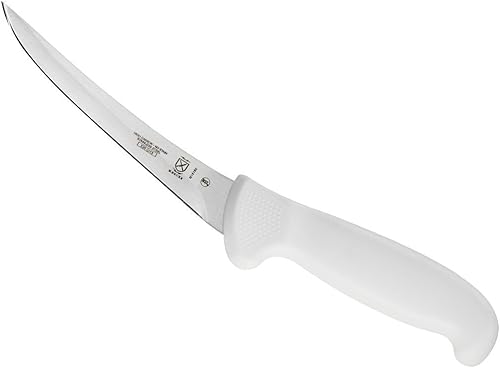
Separating meat from bone requires a thin, flexible blade that curves around joints and follows contours. The Mercer Culinary Renaissance 6-inch boning knife delivers that flexibility at a price point that culinary students and working line cooks can afford. If you break down whole chickens, debone thighs, or trim silverskin from tenderloins, this is the blade for the job. For a broader look at knives designed for meat work, see our guide to the best knife for cutting meat.
★★★★½ (5,530 reviews)
Mercer Culinary forges this blade from high-carbon German steel with a taper-ground edge. The curved blade flexes enough to hug bones without snapping, while the narrow profile slips between joints where a chef knife would jam. The ergonomic Santoprene handle, a rubber-like thermoplastic, stays grippy even when your hands are slick with poultry juices or rendered fat.
A boning knife is a specialist tool. You will not use it every day. But when a recipe calls for deboned duck breast or butterflied leg of lamb, no other blade in the kitchen gets the job done as cleanly or with as little waste.
Mueller 7-Inch Meat Cleaver: Best Kitchen Knives Cleaver Pick
A cleaver does what no other kitchen knife should attempt: chopping through bone, splitting lobster shells, and smashing garlic cloves flat. The Mueller 7-inch meat cleaver packs enough weight into a broad rectangular blade to power through chicken spines, pork ribs, and root vegetables like celeriac without the lateral stress that would chip a thinner blade.

★★★★½ (2,689 reviews)
Mueller uses 3Cr14 stainless steel for this cleaver, a grade chosen for toughness over hardness. The blade is thick, heavy, and designed to absorb impact rather than hold a razor edge. That is exactly what you want in a cleaver. A hard, thin blade would chip on the first bone strike.
The wide blade doubles as a bench scraper for transferring chopped ingredients from cutting board to pot. In Chinese cooking, the cleaver is the only knife in the kitchen, used for everything from mincing ginger to flattening chicken breasts. The Mueller is a solid entry point for home cooks who want to add a cleaver to their rotation.
Best Kitchen Knives Compared
| Knife | Type | Blade Length | Steel | Best For | Rating |
|---|---|---|---|---|---|
| Wüsthof Classic | Chef Knife | 8 in | High-Carbon Stainless (58 HRC) | All-purpose cutting, daily workhorse | 4.8★ |
| Victorinox Fibrox Pro | Chef Knife | 8 in | High-Carbon Stainless (56 HRC) | Budget all-purpose, culinary school standard | 4.8★ |
| Tojiro DP Gyuto | Japanese Chef | 8.2 in | VG-10 Cobalt (60 HRC) | Precision slicing, vegetables, fish | 4.7★ |
| Victorinox Swiss Classic Santoku | Santoku | 7 in | High-Carbon Stainless | Slicing, dicing, mincing; smaller hands | 4.8★ |
| Victorinox Paring | Paring | 3.25 in | High-Carbon Stainless | Peeling, trimming, detail work | 4.7★ |
| Victorinox Fibrox Bread | Bread Knife | 10.25 in | High-Carbon Stainless (Serrated) | Crusty bread, tomatoes, layer cakes | 4.8★ |
| Mercer Culinary Boning | Boning Knife | 6 in | High-Carbon German Steel | Deboning poultry, trimming silverskin | 4.7★ |
| Mueller Cleaver | Cleaver | 7 in | 3Cr14 Stainless | Chopping bone, smashing garlic, heavy tasks | 4.7★ |
How to Pick the Right Kitchen Knife
Picking the best kitchen knives comes down to matching blade geometry to the tasks you do most. Here is how to narrow the field.
Start with a chef knife. If you own zero knives and cook at home regularly, buy a chef knife. An 8-inch blade handles 80-90 percent of kitchen cutting: vegetables, herbs, boneless meat, and fruit. The Wüsthof Classic and Victorinox Fibrox Pro both cover this ground. Choose the Wüsthof for long-term edge retention, or the Victorinox if you want strong performance at a lower entry point.
Add a paring knife second. A chef knife cannot peel a shallot, core a strawberry, or devein a shrimp with precision. A paring knife fills that gap. Those two knives (chef and paring) handle the vast majority of home cooking tasks, according to knife guides published by both Serious Eats and Cook’s Illustrated.
Add a bread knife if you bake or buy artisan loaves. A serrated blade is the only clean way to slice crusty bread without flattening the interior. It also slices tomatoes better than most dull chef knives.
Specialty blades come last. A santoku replaces a chef knife for cooks who prefer a shorter, flatter blade. A boning knife is worth owning only if you regularly break down whole poultry or debone cuts. A cleaver is a specialist tool for splitting bones and heavy-duty prep. Build your knife collection around your actual cooking habits, not around a target number of knives to own.
Knife Care That Extends Blade Life
A good knife degrades fast without basic maintenance. The USDA’s food safety guidelines address cutting surface hygiene, but blade care matters just as much for both safety and performance.
Hone before every use. A honing steel realigns the blade edge — it does not remove metal. Running the blade along a ceramic or steel rod at a consistent angle (matching the factory edge, usually 14-20 degrees per side) keeps the edge straight between sharpenings. Food science author Harold McGee notes in On Food and Cooking that a misaligned edge folds under pressure during cutting, which makes the knife feel dull even when the steel itself is still sharp.
Sharpen two to four times per year. A whetstone (1000/6000 grit combination) restores a true edge by removing a thin layer of steel. Electric sharpeners work faster but remove more material and can overheat the blade, which may affect the temper. For home cooks who do not want to learn freehand sharpening, a guided sharpening system like a Lansky or WorkSharp produces consistent results.
Hand wash and dry immediately. Dishwasher detergent is abrasive. The high-pressure spray tosses knives against racks. Both degrade the edge and can pit the blade over time. A quick hand wash with soap, a towel dry, and storage in a block or on a magnetic strip is all it takes.
Frequently Asked Questions About Kitchen Knives
Home cooks regularly ask which brands make the best kitchen knives, how to maintain their edges, and how often to replace them. The answers depend on the steel grade, how often you cook, and how well the blade is maintained between uses. Below are the questions that come up most, drawn from buyer review patterns and cooking community discussions.
What is the best kitchen knife for a beginner?
The Victorinox Fibrox Pro 8-inch chef knife is the most recommended beginner knife across professional review sites. Its low entry cost means a new cook can learn proper technique (rocking cuts, dicing, mincing) without worrying about damaging an investment-grade blade. The Fibrox handle is forgiving for cooks still developing their pinch grip. Start with this knife and a basic honing steel. Upgrade to a Wüsthof or Japanese blade once your technique and preferences are established.
Who makes good kitchen knives?
Four brands dominate professional and consumer reviews: Wüsthof (German, forged), Victorinox (Swiss, stamped), Shun (Japanese, forged), and Tojiro (Japanese, laminated). German knives favor durability and a heavier feel. Japanese knives favor sharpness and a lighter blade. Mercer Culinary is a strong contender in the value segment, particularly for boning and utility knives. The best kitchen knife brands share one trait: they publish their steel specifications and stand behind their products with warranty programs.
How often should kitchen knives be sharpened?
For a home cook who prepares dinner five to six nights a week, sharpening two to four times per year is typical. Honing on a steel rod before each use extends the interval. A knife is due for sharpening when it no longer slices through a ripe tomato under its own weight or when it tears rather than cuts herbs. Harder steels (60+ HRC, like VG-10) hold an edge longer but require a finer grit stone when they do need work. Softer steels (56-58 HRC, like Victorinox) dull faster but resharpen in minutes.
Do I need a full knife set or should I buy individual knives?
Buy individual knives. Pre-packaged knife sets include filler blades (steak knives, a utility knife, kitchen shears) that pad the piece count but rarely get used. A chef knife, a paring knife, and a bread knife cover 95 percent of home cooking tasks. Add specialist blades (boning, cleaver, santoku) only as your cooking habits demand them. You will spend less money and end up with better knives by buying three quality individual blades than by purchasing a 15-piece block set.
How often should you replace kitchen knives?
A well-maintained kitchen knife made from quality steel can last decades. Wüsthof offers a lifetime warranty on its Classic line. Victorinox knives routinely survive 10+ years of daily commercial kitchen use. Replacement is warranted only if the blade develops chips that cannot be ground out, the handle cracks or loosens from the tang, or the blade has been sharpened so many times that it has lost significant width. If your knife feels dull, it almost certainly needs sharpening, not replacing.
What is the difference between forged and stamped kitchen knives?
Forged knives are shaped from a single piece of heated steel, usually with a full tang and bolster. They tend to be heavier, more balanced, and more expensive. The Wüsthof Classic is forged. Stamped knives are cut from a sheet of steel like a cookie cutter, then ground and heat-treated. They are lighter and typically cost less. The Victorinox Fibrox Pro is stamped. Both methods produce excellent knives. The distinction matters less than the steel quality and heat treatment behind it.
Home Chef Ninja is reader-supported. When you buy through links on this page, we may earn a commission. We only recommend products we would use ourselves.
This article is for informational purposes only and is not legal, medical, or financial advice. Circumstances vary; consult a qualified professional about your situation.