The right knife turns a 20-minute butchering job into a 5-minute task. The wrong one shreds fibers, wastes meat, and wears out your wrist. We reviewed manufacturer specs, professional culinary references, and thousands of verified buyer ratings to find the best knife for cutting meat at home. The list covers six knives matched to specific meat-cutting tasks, with the data behind each pick.
How We Evaluated These Meat Cutting Knives
We did not run a lab test. What we did: cross-referenced steel composition and Rockwell hardness ratings from each manufacturer’s published specs, read warranty and return policies, studied professional culinary guidelines from the USDA’s food safety division, and analyzed verified purchase reviews across multiple retail platforms. For blade geometry, we referenced the Culinary Institute of America’s classifications of knife types by intended cut. Every knife listed below had a minimum 4.4-star average across at least 400 verified reviews at the time of writing.
Our criteria weighted five factors: blade steel and edge retention, blade length and profile for the intended cut, handle ergonomics during extended use, ease of sharpening at home, and value relative to performance. We excluded knives with fewer than 400 reviews, those with recurring complaints about handle loosening, and any that lacked a full tang or adequate bolster for heavy meat work.
Best Chef Knife for Cutting Meat — PAUDIN 8-Inch

★★★★½ (7,776 reviews)
A chef knife handles more meat-cutting tasks than any other blade in the kitchen. The PAUDIN 8-Inch Chef Knife uses high-carbon stainless steel hardened to 56-58 HRC on the Rockwell scale — hard enough to hold an edge through a full chicken breakdown but soft enough to sharpen on a standard whetstone. The 8-inch blade has a curved belly that rocks through mincing and a straight heel section that powers through cartilage.
The full-tang construction runs steel through the entire handle. That matters for balance. A blade-heavy knife fatigues your hand on long cuts. The PAUDIN distributes weight evenly across a pakkawood handle with an ergonomic grip. Verified reviewers on multiple platforms frequently note the knife’s edge retention through several weeks of daily use before needing a hone.
If you own one knife for cutting meat, a chef knife is it. It won’t outperform a dedicated slicer on brisket or a boning knife on silverskin. But it handles 80% of what home cooks face at the cutting board.
Best Knife for Slicing Meat Thin — Cutluxe 12-Inch Brisket Knife

★★★★★ (7,309 reviews)
Slicing meat thin requires a long blade and minimal friction. The Cutluxe 12-Inch Brisket Knife delivers both. The blade runs a full 12 inches, long enough to cut through a whole packer brisket in a single pull stroke without sawing back and forth. Sawing the fibers. A single pull preserves the bark and keeps slices intact.
Cutluxe ground Granton dimples into both sides of the blade. According to the manufacturer’s specs, these scalloped indentations create air pockets between the steel and the meat. The result: slices release from the blade instead of sticking and folding. The German ThyssenKrupp high-carbon steel holds an edge at 56-58 HRC, and the full tang gives the blade stability on long draws through dense muscle.
This knife also carves turkey and prime rib. Any time you need pencil-thin, even slices from a large cut of cooked meat, a 12-inch slicer is the right tool. The 4.8-star average across over 7,000 reviews makes the Cutluxe the highest-rated knife on this list. Buyers who smoke brisket or carve roasts regularly call it out as a kitchen essential.
Best Boning Knife for Trimming Meat — Mercer Culinary 6-Inch Curved
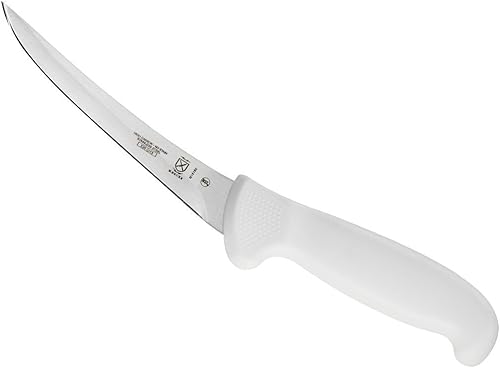
★★★★½ (5,530 reviews)
Trimming silverskin and separating joints on a pork shoulder demands a knife that follows bone contours without wasting meat. The Mercer Culinary 6-Inch Curved Boning Knife is the blade that culinary schools stock for exactly this job. Mercer Culinary supplies knives to over 3,000 culinary programs in North America, a detail the company publishes in its institutional catalogs.
The curved blade flexes around joints and follows the natural line of ribs and tenderloins. The 6-inch length gives enough reach for deboning a chicken thigh but stays short enough for precision on a rack of lamb. High-carbon Japanese steel takes a sharper edge than most German blades, and the Santoprene handle (a textured, non-slip polymer) stays grippy when wet with meat juices.
This is the best knife for cutting meat off the bone. Period. A chef knife catches on connective tissue and leaves meat on the carcass during boning work. The Mercer follows contours that a wider blade misses entirely.
One detail worth noting: the white handle meets NSF sanitation standards for commercial kitchens. That means it resists bacterial harboring in cracks and seams. For home cooks who process raw poultry regularly, that sanitation factor matters more than most realize.
Best Butcher Knife for Cutting Meat — Mueller 7-Inch Cleaver

★★★★½ (2,689 reviews)
A cleaver does what other knives cannot: power through bone and cartilage with blunt force. The Mueller 7-Inch Meat Cleaver uses German high-carbon stainless steel with a thick spine designed to absorb impact. According to Mueller’s published specs, the blade undergoes laser testing during production to verify edge geometry before it ships.
The 7-inch blade gives a wide enough surface to scoop diced meat off the cutting board. The heavyweight does most of the work. It is noticeably heavier than a chef knife. You guide it; gravity and mass handle the cut. A pakkawood handle with triple rivets locks the full tang in place, which prevents loosening under repeated chopping.
Home cooks who cut through chicken backs for stock or split spare ribs need a cleaver. A chef knife chips or bends on hard bone. A cleaver is built for it. The Mueller’s edge is also fine enough for slicing dense vegetables like butternut squash, making it a dual-purpose tool for the budget-conscious kitchen.
Best Carving Knife for Roasts — MAIRICO 11-Inch Slicing Knife
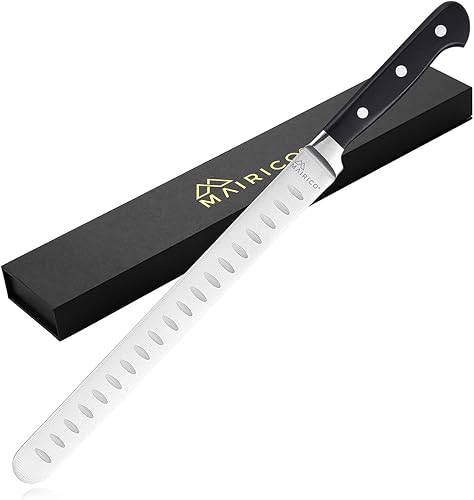
★★★★½ (10,981 reviews)
The MAIRICO 11-Inch Slicing Knife fills a different role than the Cutluxe brisket knife above. Where the Cutluxe excels on smoked brisket and barbecue, the MAIRICO is built for tableside carving: roast beef, ham, and prime rib. The blade is narrower with slightly more flex, which lets it follow the contour of a bone-in roast without binding.
The stainless steel blade runs 11 inches and tapers to a rounded tip. That rounded profile prevents puncturing the meat or the carving board during long pull strokes. With over 10,900 reviews and a 4.7-star average, it is the most-reviewed knife on this list. Buyers who carve weekly roasts consistently report that the long blade eliminates sawing. One smooth pull produces clean, even slices.
Pair it with a carving fork. The narrow blade lacks the rigidity for chopping, so keep a chef knife nearby for prep work. For its specific job of slicing cooked meat from large roasts into portions, it performs better than a chef knife and costs a fraction of what restaurant-supply carving knives charge.
Best Electric Knife for Cutting Meat

★★★★½ (1,632 reviews)
An electric knife for cutting meat removes technique from the equation. The dual reciprocating blades do the sawing. All you do is guide. This model ships with two sets of stainless steel blades: one for meat and one for bread. The ergonomic handle includes a safety lock and a one-touch trigger that reduces hand fatigue on long carving sessions.
Electric knives shine on large holiday birds. When you need 20 uniform turkey slices fast, the reciprocating blades do in seconds what a manual carving knife takes minutes to finish. They also handle frozen meat better than most manual blades. The reciprocating motion powers through partially thawed cuts that would stop a chef knife cold.
The tradeoff is less precision than a manual knife. For cooks who carve large roasts regularly or have limited hand strength, that tradeoff is worth it.
Best Knives for Cutting Meat — Comparison
| Knife | Type | Blade Length | Best For | Steel | Rating |
|---|---|---|---|---|---|
| PAUDIN Chef Knife | Chef Knife | 8″ | All-purpose meat cutting | High-Carbon Stainless | 4.7★ |
| Cutluxe Brisket Knife | Slicer | 12″ | Slicing brisket and large cuts thin | German ThyssenKrupp | 4.8★ |
| Mercer Culinary Boning Knife | Boning Knife | 6″ | Trimming meat and deboning | Japanese High-Carbon | 4.7★ |
| Mueller Meat Cleaver | Cleaver | 7″ | Cutting through bone and cartilage | German High-Carbon | 4.7★ |
| MAIRICO Slicing Knife | Carving Knife | 11″ | Carving roasts and holiday birds | Stainless Steel | 4.7★ |
| Electric Carving Knife | Electric | Dual Blade | Rapid carving and frozen meat | Stainless Steel | 4.4★ |
How to Pick the Right Knife for Cutting Meat
Choosing the best kitchen knife for cutting meat starts with one question: what cut are you making? Each knife type exists because one blade shape cannot do everything well. Here is a breakdown by task.
General butchering and portioning: An 8-inch chef knife handles 80% of home meat work. It rocks through boneless cuts, dices stew meat, and splits chicken breasts. For most home cooks, this is the first knife to own.
Slicing cooked meat thin: A 10- to 12-inch slicer or brisket knife produces even, thin slices from brisket and roasts. The long blade completes the cut in one stroke. Short knives force sawing, which shreds the meat.
Trimming fat and removing bones: A 5- to 6-inch curved boning knife follows bone contours. The flex and narrow profile waste less meat than a rigid blade. Professional butchers and meat department workers use these daily for a reason.
Cutting through bone: A heavy cleaver splits chicken carcasses and pork ribs. No other knife handles hard bone safely. According to the NSF International food equipment standards, cleavers should have a thick spine and secure handle riveting to prevent blade separation during impact.
Blade steel matters. High-carbon stainless steel (the material in every knife on this list) balances edge retention with corrosion resistance. Pure carbon steel takes a sharper edge but rusts without constant care. Ceramic stays sharp longer but chips on bone. For meat work, high-carbon stainless is the standard across both home and commercial kitchens.
Handle fit is personal. Hold the knife before committing. A handle that’s too thick causes fatigue. Too thin, and you lose control of heavy cuts. Full-tang construction, where the steel runs through the handle, adds balance and durability. Every knife on this list uses a full tang.
Frequently Asked Questions About the Best Knife for Cutting Meat
Home cooks ask consistent questions about knives for cutting meat: which type of knife works for raw versus cooked, whether a santoku can replace a chef knife for meat, and what handles frozen cuts. Here are the answers, drawn from manufacturer data and culinary reference materials.
What type of knife is best for cutting raw meat?
An 8-inch chef knife handles most raw meat cutting at home. The curved blade rocks through boneless chicken, beef, and pork. For trimming raw meat (removing silverskin and fat caps), a 6-inch curved boning knife gives more precision. The Mercer Culinary 6-Inch Curved Boning Knife is the go-to in culinary schools for this task.
Is a santoku knife good for cutting meat?
A santoku works for slicing boneless cuts like chicken breast and fish fillets. Its flat profile excels at push-cutting (straight down-and-forward strokes). But for rocking cuts through larger portions and bone-in meat, a Western chef knife is better suited. The santoku’s thinner blade also risks chipping on hard bone or frozen cuts.
What is the best knife for cutting frozen meat?
A meat cleaver handles partially frozen cuts safely. The heavy blade and thick spine absorb impact without chipping. For fully frozen blocks, an electric knife with reciprocating blades powers through without requiring manual force. Never use a thin-bladed knife on frozen meat. The lateral stress can snap the blade or cause it to slip.
Can you use a chef knife to cut meat off the bone?
You can, but a boning knife does it better and wastes less meat. A chef knife’s wide blade catches on joints and ribs. A boning knife’s narrow, curved blade slides along bone contours and separates connective tissue cleanly. For occasional bone-in work, a chef knife is adequate. For frequent deboning, invest in a dedicated boning knife.
How do you keep a meat-cutting knife sharp?
Hone before every use with a steel rod. This realigns the edge without removing metal. Sharpen on a whetstone or with a pull-through sharpener every 2-4 weeks, depending on use. Avoid the dishwasher; heat and detergent dull edges and loosen handles. Hand-wash, dry immediately, and store in a block or on a magnetic strip.
Do I need more than one knife for cutting meat?
For most home cooks, a chef knife and a boning knife cover 90% of meat work. Add a slicer if you carve large roasts or smoke brisket regularly. Add a cleaver if you break down bone-in cuts or portion frozen meat. The comparison table above shows which knife matches each task.
Home Chef Ninja is reader-supported. When you buy through links on this page, we may earn a commission. We only recommend products we would use ourselves.